




















Prepared by the Dermapure team of specialists. Last updated: 22 November 2026.
A lip augmentation simulation is a preview of the result, prepared on a photograph of the patient before any product is injected. At Dermapure we create it in our own simulator: the software measures the real shape of the lips, and the target shape is modelled by our specialist, drawing on their own experience. The preview therefore shows a change that is achievable with that particular lip structure, not an idealised result.
In brief
- We prepare the simulation at the patient’s request, during a free, no-obligation consultation, on a photograph taken at the clinic.
- The software traces the real outline of the lips and marks the midline, then shows the change in the chosen areas of the lips.
- The target shape is decided by the specialist, who sets how much product goes into the upper lip, the lower lip and the corners.
- The same amount of product gives a different result in different people, which is why every simulation is made on the photograph of that particular patient.
- A simulation is a preview rather than a promise: it shows the direction of the change, while the final appearance of the lips is assessed once they have healed.
What a lip augmentation simulation is
A simulation is a photograph of the patient with the change in lip shape applied to it, prepared during the consultation. The patient sees the starting point and the preview of the result for the chosen amount of product side by side, before any decision about the treatment is made.
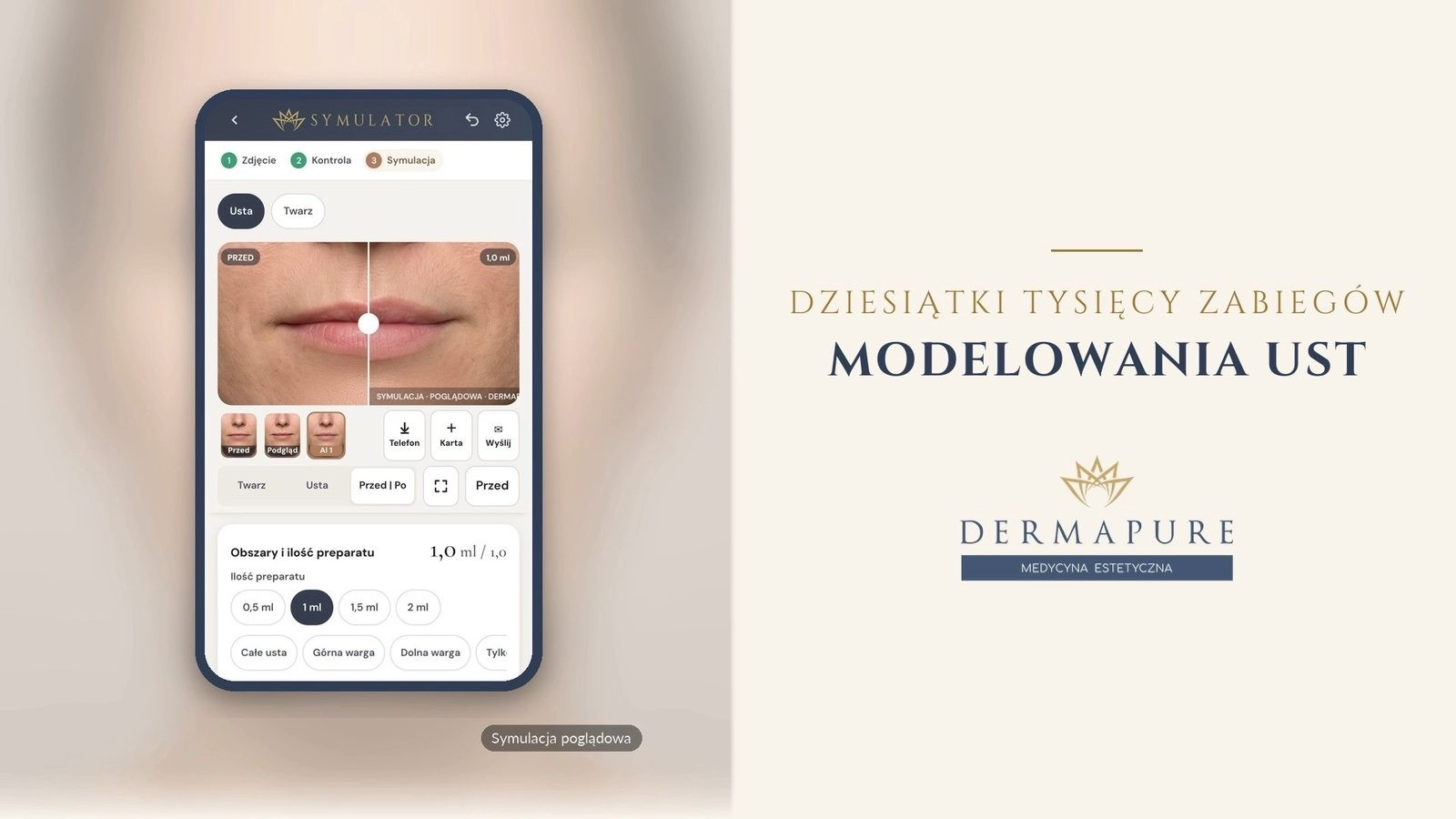
The simulator was built at Dermapure, out of the experience of tens of thousands of lip contouring treatments we have performed. We use it only during our own consultations. It is not a publicly available app or a photo filter, so it cannot be run at home.
Why visualisations from publicly available AI tools are misleading
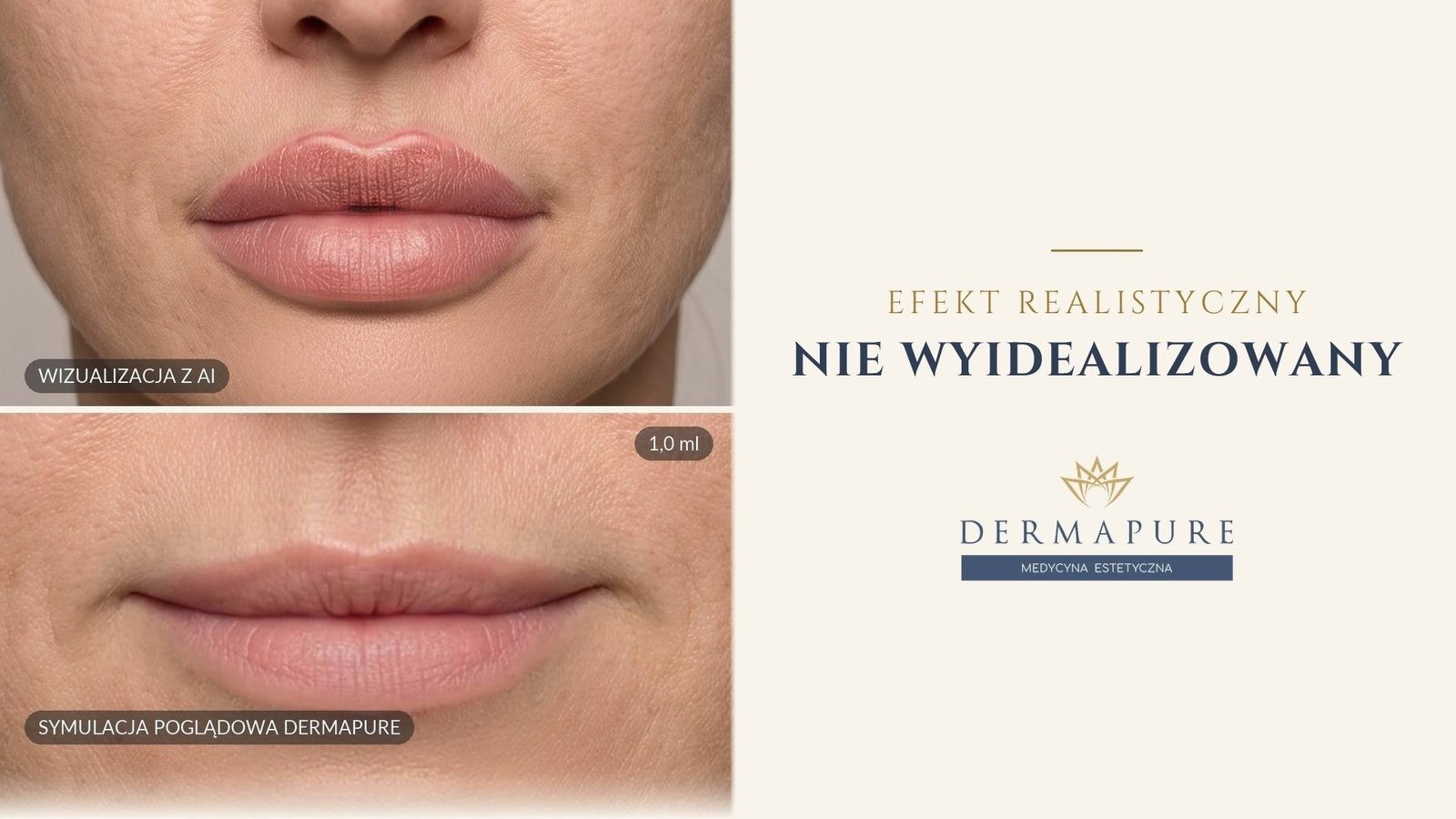
More and more patients come to the consultation with a ready-made lip visualisation prepared in a publicly available tool based on artificial intelligence. Such a tool usually imposes one pattern of lips: the same bow, the same fullness, the same width of the vermilion, regardless of how that person’s lips and face are built.
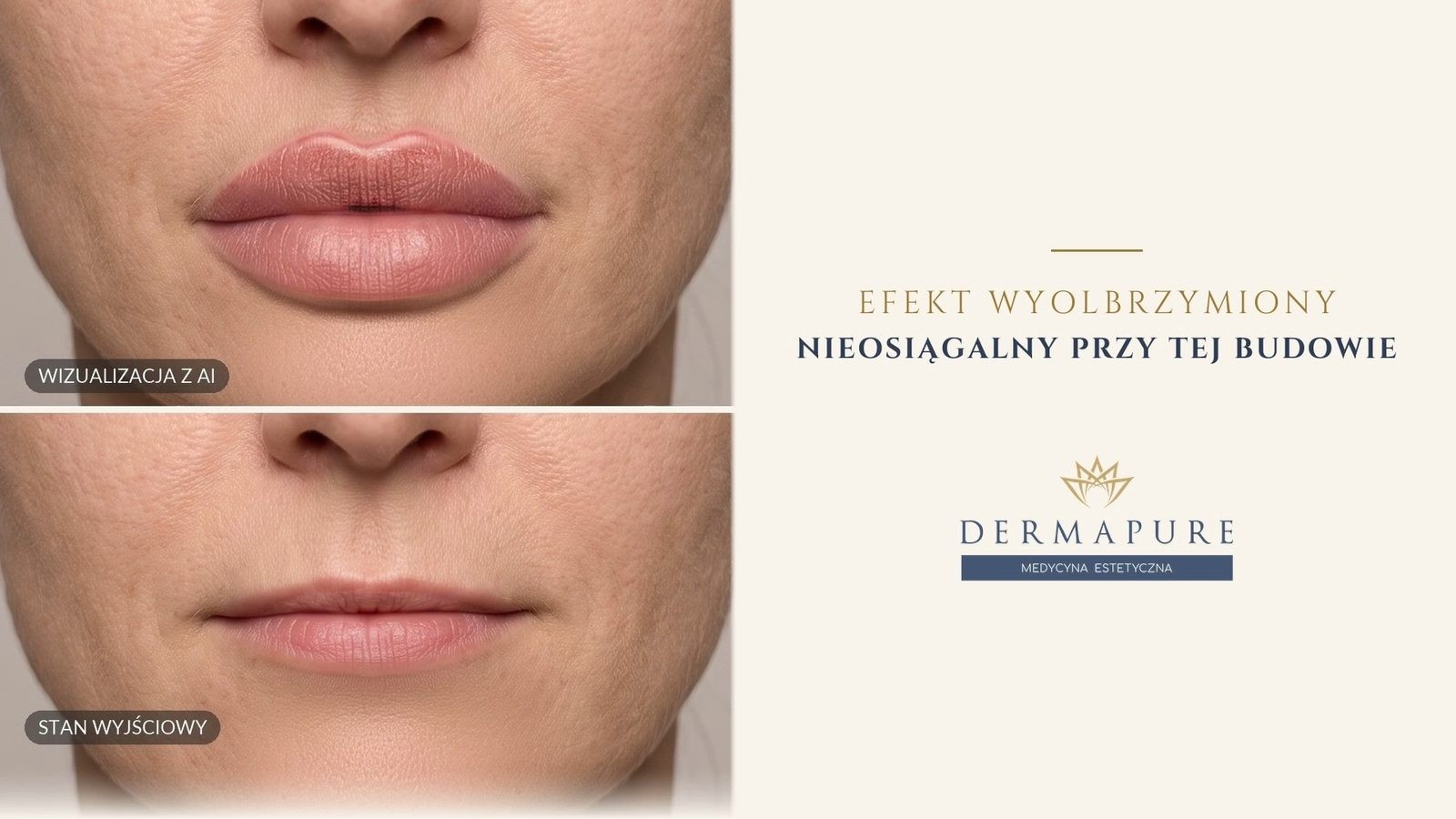
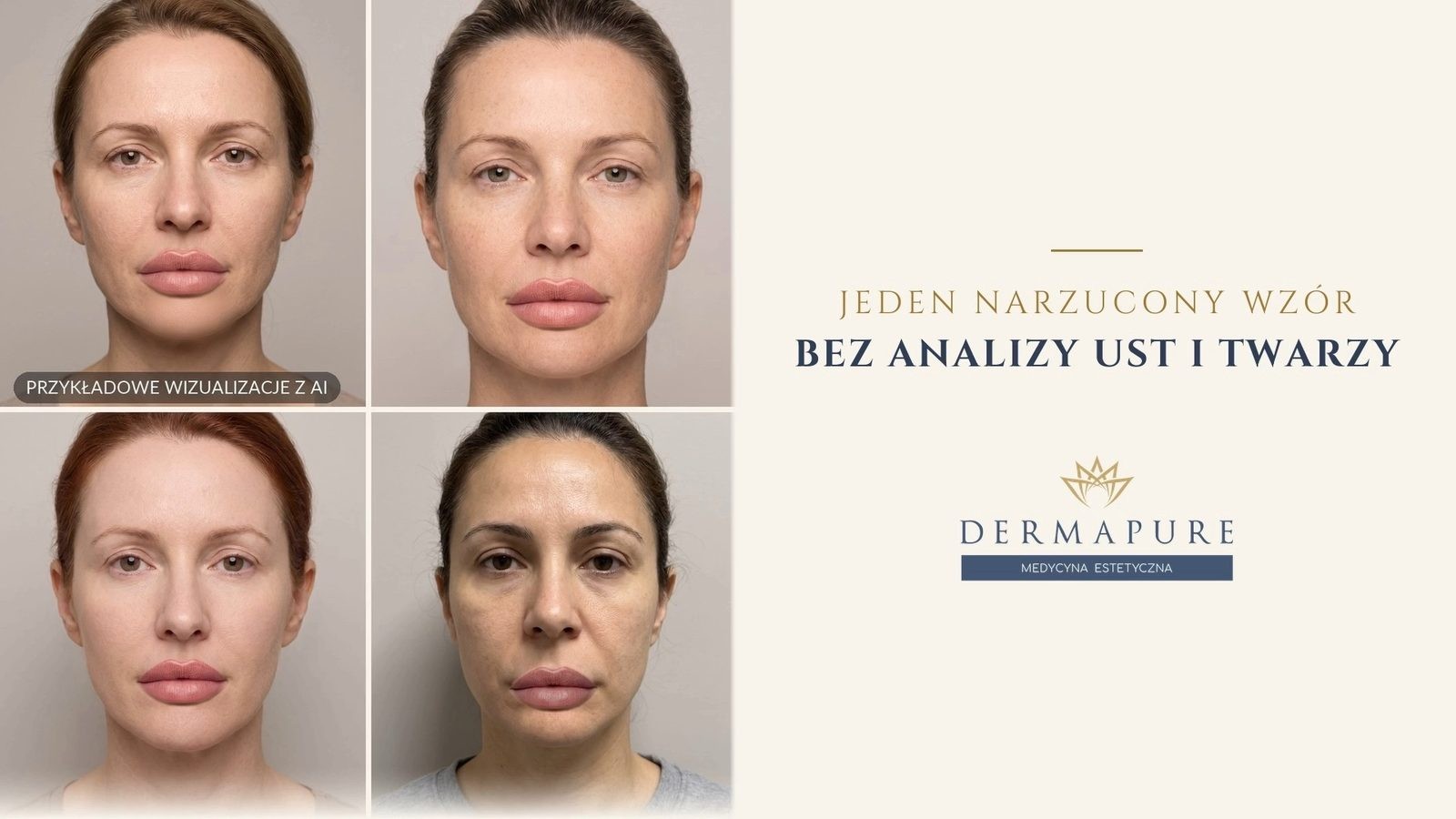
The effect becomes clear once the same pattern is applied to several different faces. The lips then match the picture but stop matching the face: they are too wide, too tall or positioned differently from that person’s midline and proportions.
Research does not support the existence of a single lip pattern suitable for everyone. A survey published in 2017 collected 1,011 responses from 35 countries, with participants free to change the shape of the lips on a photograph of one model. Preferred lip fullness differed significantly depending on the country of residence, ethnic background and whether the respondent was a specialist or a layperson. The authors noted that the frequently quoted “ideal proportions” need to be placed in context, and that a mismatch of expectations can be a source of dissatisfaction with the result.
A 2018 review asking whether ideal lips can be defined reaches a similar conclusion. Its authors always describe the features of ideal lips in relation to a particular face: the proportions of the face, the relationship between the upper and lower lip, and ethnic and sex-related differences. These findings concern the participants in the studies cited and are not a promise for any individual.
How the Dermapure simulator measures the lips
The software traces the real outline of the lips on the patient’s photograph, marks the midline and reads the proportions: the relationship between the upper and lower lip, the width of the vermilion and the differences between the two sides.
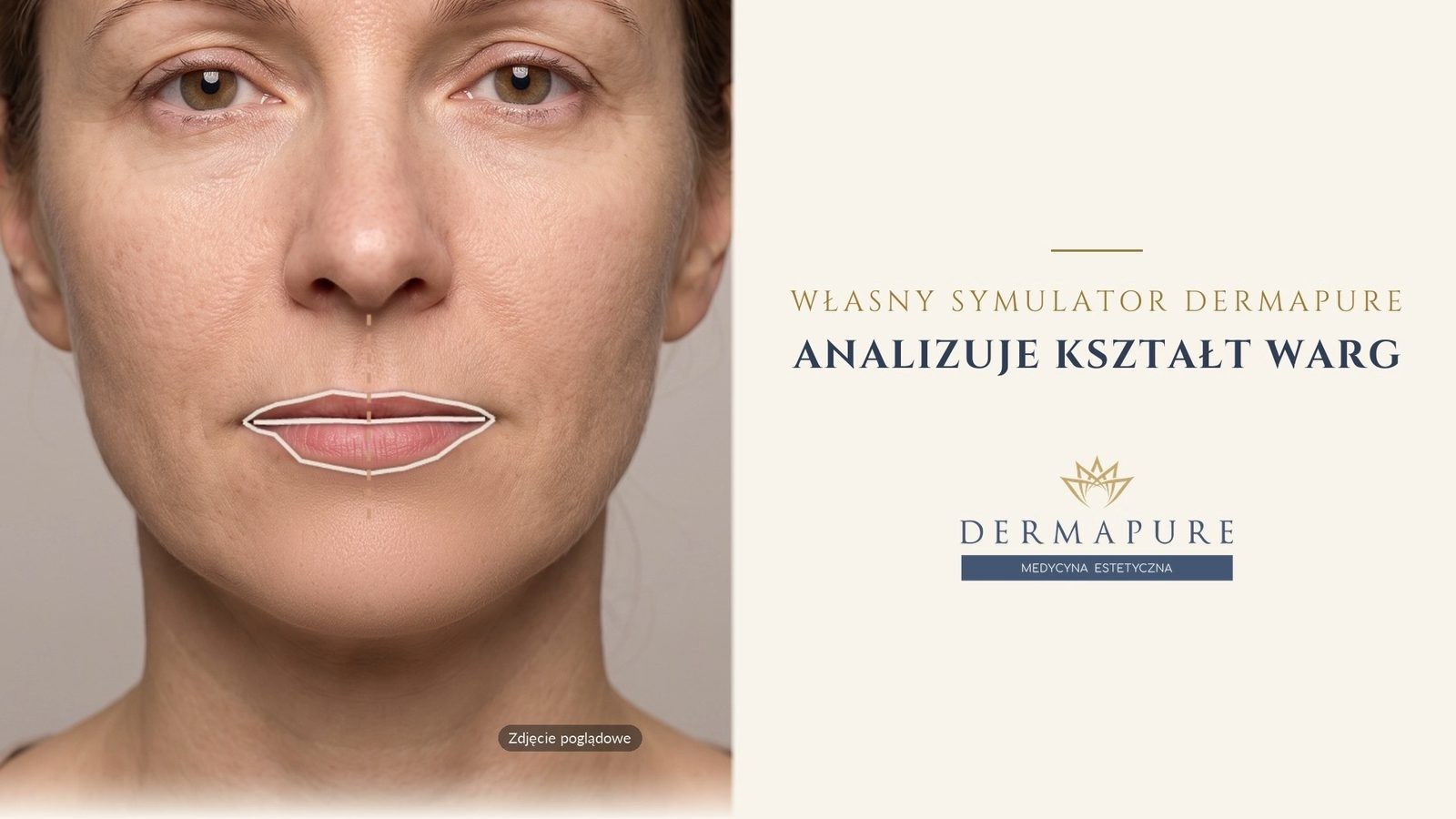
This measurement is the reason the preview looks different for every patient. The change is applied to the lip shape the patient has on the day of the consultation.
What the software measures on the photograph
The simulator works on a mesh of almost five hundred points spread across the face. Before it calculates anything, it has to establish how many millimetres one pixel of the photograph represents, because otherwise the result would depend on the distance the photograph was taken from.
The scale comes from the iris. In adults it measures about 11.7 mm and varies little from person to person, and its diameter does not change with the light, unlike the diameter of the pupil. The software measures both irises, averages the result, and from that point on reports lip dimensions in millimetres rather than in pixels.
The lips themselves are described by seven cross-sections spread from one corner to the other. At each of them the height of the vermilion is calculated separately for the upper and the lower lip. Added to that are the two peaks of the Cupid’s bow and the width of the mouth measured between the corners.
The reference points are the places that product injected into the lips does not move: the outer corners of the eyes, the bridge and the tip of the nose, the forehead and the chin. They make it possible to compare the photograph before the treatment with the photograph after it on the same scale, even if the patient sits down slightly differently.
The software also assesses the quality of the photograph itself. If the head is turned or tilted by more than a few degrees, the photograph is out of focus, or the light falls unevenly, the app asks for a new photograph before it accepts it for measurement.
The target shape is modelled by the specialist
The target shape of the lips is set by the specialist, who assesses the proportions of the whole face, the structure and quality of the tissues, and the patient’s expectations, and then decides how much product goes into the upper lip, how much into the lower lip and how much into the corners. In this preview, artificial intelligence adds only texture and light, so that the image looks natural.
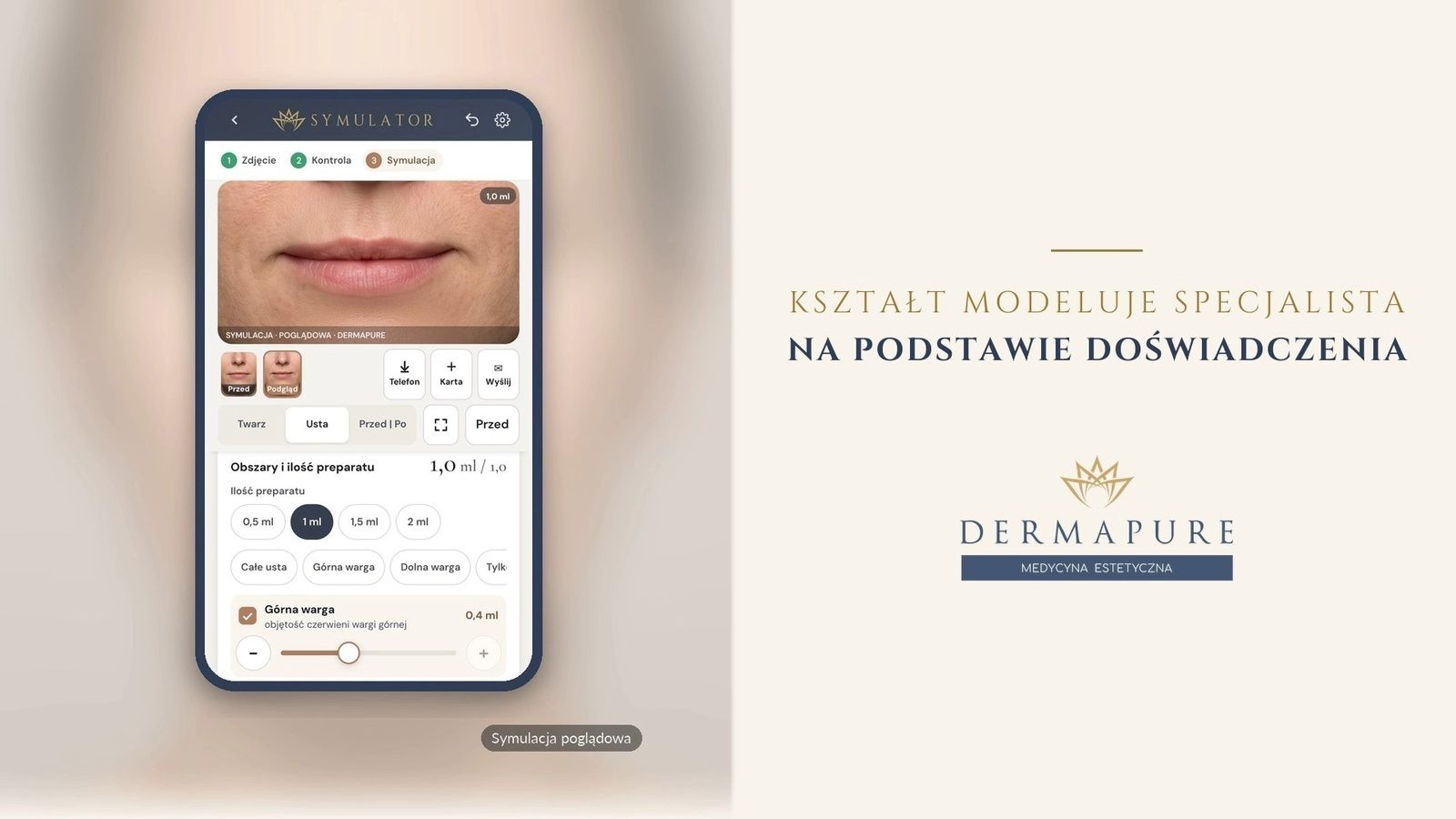
This division of work comes from our experience in lip contouring. The software measures what can be measured, while assessing the anatomy and choosing the technique remain with the person running the consultation.
Why we do not aim for mirror symmetry
The simulator measures the difference between the two sides of the lips and evens out only part of it. A natural face remains slightly asymmetrical, and we regard a fully mirrored correction as unnatural.
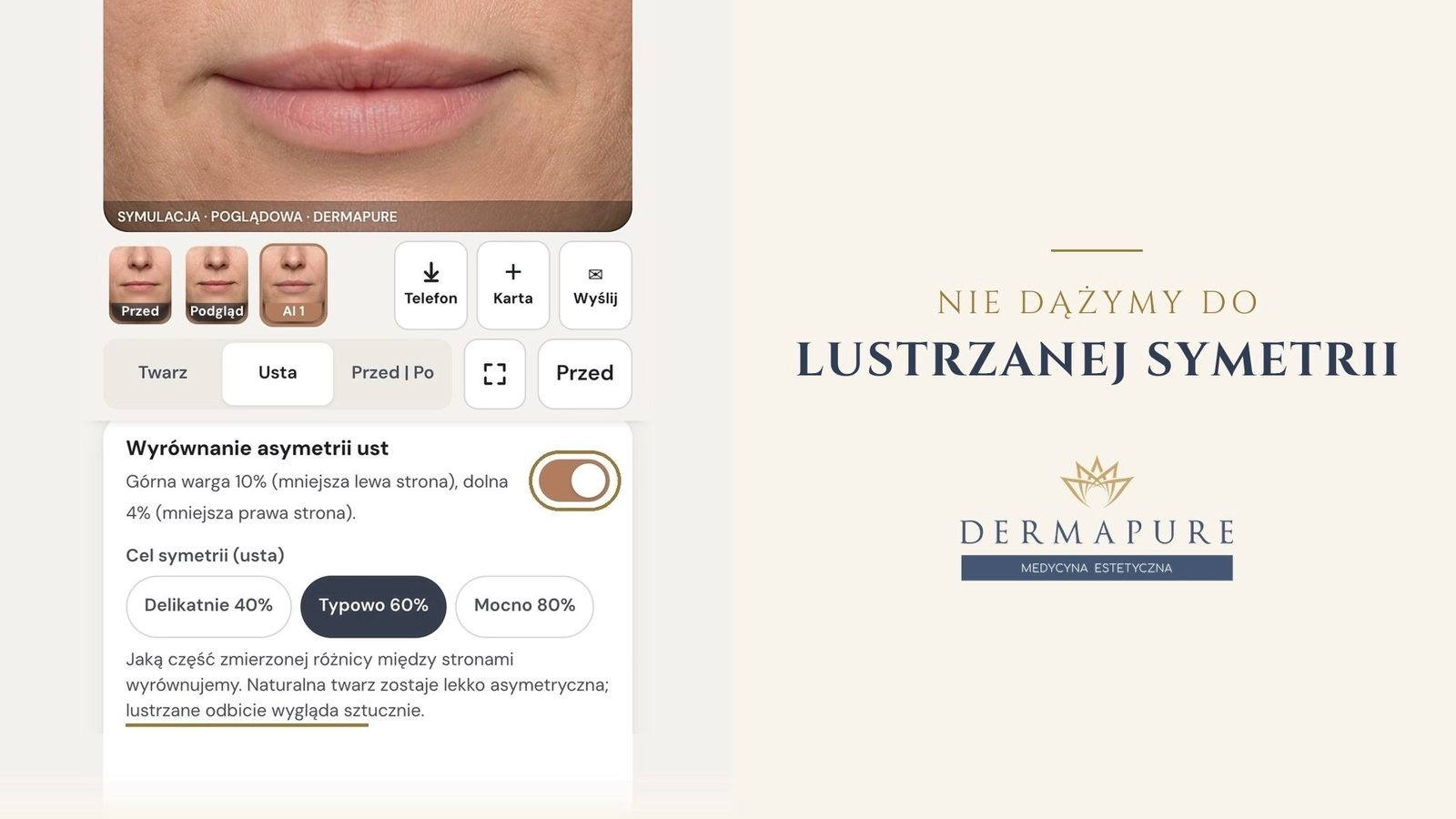
Studies confirm how common facial asymmetry is. A study published in 2015 examined 565 people aged 18 to 68 and found some degree of facial asymmetry in every person examined. In the same study, ratings of attractiveness were not related to the level of asymmetry. An analysis of photographs of 315 patients published in 2023 found the middle and lower parts of the face to be significantly larger on the right side than on the left. These are the results of those studies, not a description of the result in any one person.
The same amount of product, a different result
One millilitre of hyaluronic acid gives a different result in different people, because the starting point differs every time. This is easiest to show in a photograph.
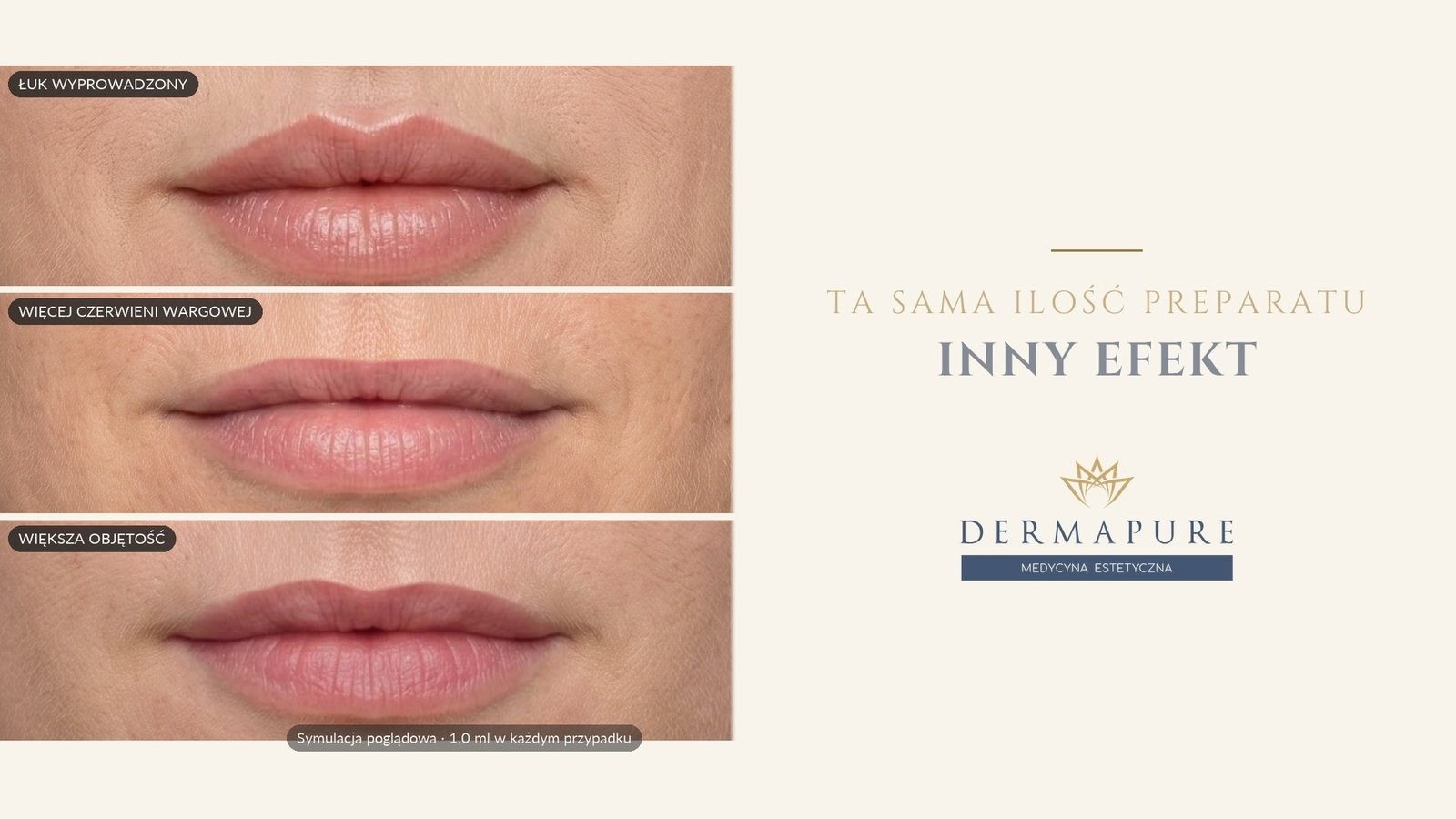
This is why the question “how will I look after one millilitre?” has no single answer until we have seen the lips themselves. The simulation turns that question into an image. The result depends on the structure of the lips and the quality of the tissues, which is why we tailor the plan to each person and discuss the expected outcome at the consultation. What half a millilitre does and what a full millilitre does is covered in our article on how much hyaluronic acid for lips: 0.5 ml or 1 ml.
Step by step: how the target shape is built
In the simulator we show the successive stages of the plan, up to the full amount of product. The patient sees what the product changes when it is injected into the upper lip, what it changes in the lower lip and what it changes in the corners, and how these stages add up.
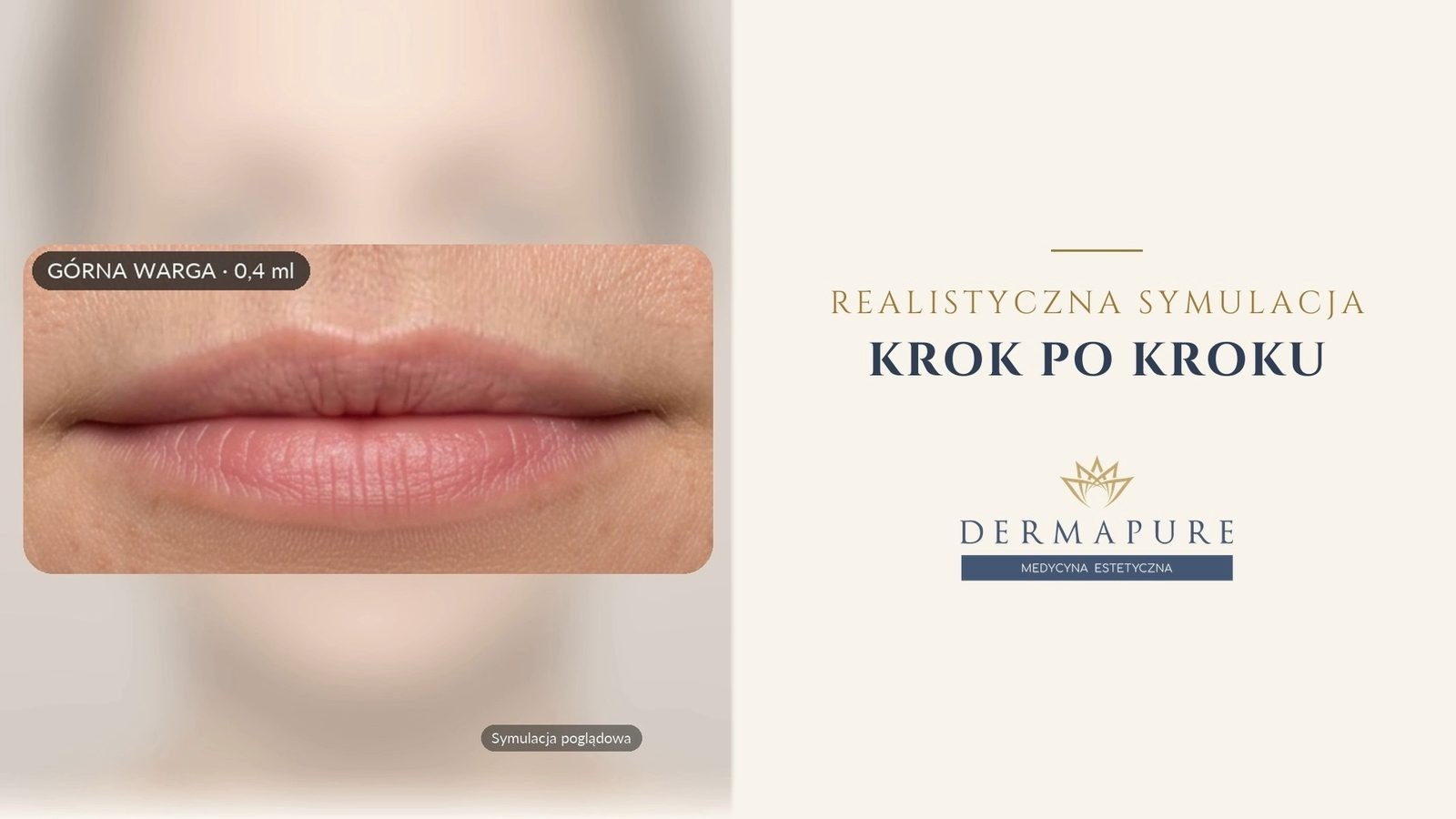
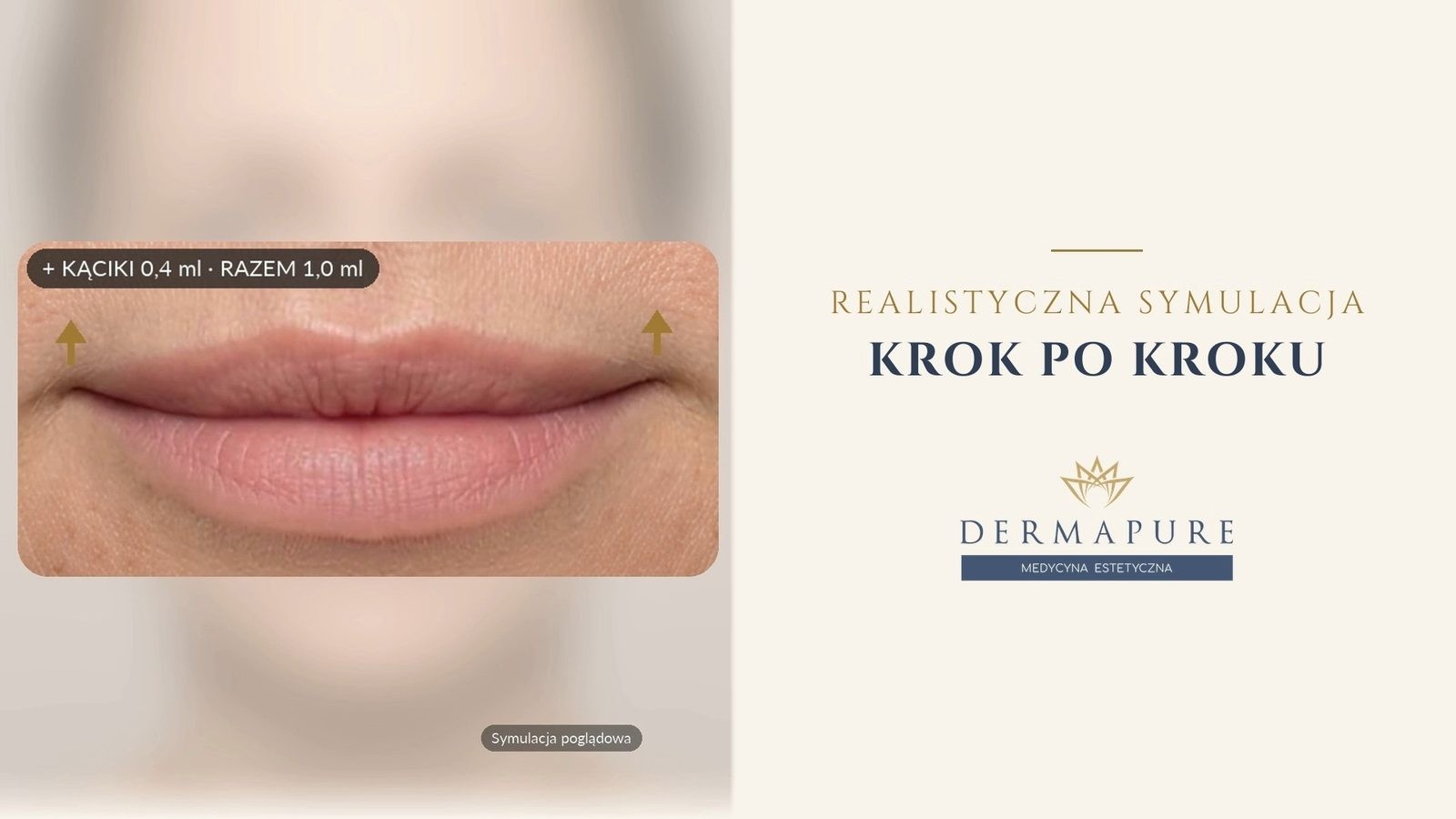
A preview like this makes it easier to talk about technique. The technique is chosen to suit the shape of the lips and the desired result, and different ways of contouring give a different line to the lips, which we describe in our article on the flat lip technique. More about the treatment itself at our clinic is on the page about lip augmentation and contouring with hyaluronic acid.
What a simulation does not show
A simulation shows the direction and the scale of the change. It cannot predict exactly how a particular person’s tissues will behave after the product is injected, or how healing will progress. That is why every preview is labelled in the app as an indicative simulation.
Nor does a simulation replace the examination and the conversation. Contraindications, previous treatments and the condition of the tissues are assessed at the consultation, and if the desired shape cannot be achieved in a given case, we say so before the treatment, before any decision is made.
The first days after the treatment and aftercare
After the product is injected, the lips are swollen, and the swelling lasts from a few days to a couple of weeks, depending on the person. Healing of the lips can take up to 2-3 weeks, so the final result is visible after about 3-4 weeks, once everything has healed. Small bruises may appear at the injection points and clear within a few days. The risk of complications is low, and we discuss contraindications and possible reactions at the consultation. We describe this day by day in our article on swelling after lip augmentation.
Aftercare is available 7 days a week. Should you have any questions after the treatment, we are available on 576 079 976, including at weekends.
What a consultation with a simulation looks like
The consultation begins with a conversation about expectations and with an assessment of the lips and the proportions of the face. If the patient wants to see the expected change, we take a photograph at the clinic, in even light, and open the simulator. The patient sees the measurement, the plan and the preview of the result on the same screen, and we explain what follows from what.
At this point it is still possible to change your mind: to reduce the amount of product, to shift the emphasis to another area of the lips, or to postpone the decision. That is precisely what the simulation is for: a patient who is unsure of the result, and does not know how it would feel to have lips of that shape, can see the change before making the decision.
Price and what it includes
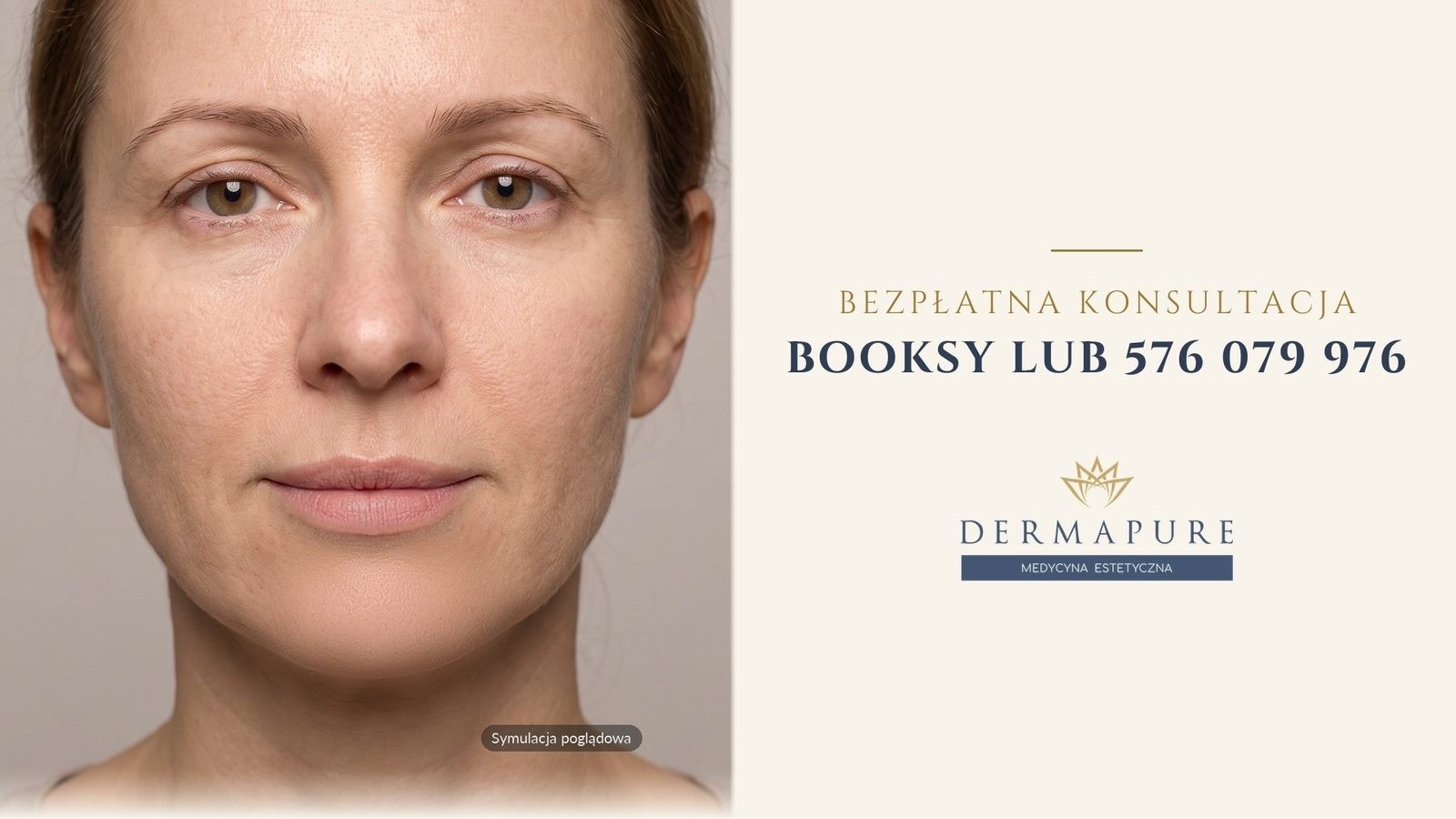
The consultation with a simulation is free and without obligation. Lip augmentation and lip contouring each cost 1300 zł at Dermapure. The price includes 1 ml of hyaluronic acid and a follow-up visit after 2 weeks, which is optional. Current prices for all treatments are in our price list.
Photos of the results of treatments performed at Dermapure are in our gallery, in the section “Lip contouring with hyaluronic acid”.
We see patients at our clinic at Grzybowska 3/U7, Warsaw (Śródmieście, 1st floor). We have more than 10 years of experience, have looked after nearly 12,000 patients and have performed over 50,000 treatments. You can book a free, no-obligation consultation through Booksy or by phone: 576 079 976.
Frequently asked questions
Is the lip augmentation simulation chargeable?
No. We prepare the simulation at the patient’s request, during a free, no-obligation consultation. It does not commit you to having the treatment on the same day.
How does the Dermapure simulation differ from a visualisation made in an AI app?
A publicly available tool applies one lip pattern regardless of the structure of the face. Our simulator measures the real lip outline of a particular patient, and the target shape is modelled by the specialist. In the preview, artificial intelligence adds only texture and light.
Will the result after the treatment be exactly the same as in the simulation?
A simulation shows the direction and the scale of the change; it cannot predict how healing will progress or how the tissues of a particular person will behave. The result depends on the structure of the lips and the quality of the tissues.
How long after the treatment does the result resemble the simulation?
The final result is visible after about 3-4 weeks, once everything has healed. Before that the picture is affected by swelling, which lasts from a few days to a couple of weeks.
Do you prepare a simulation before every lip treatment?
No, a simulation is not required. It is an additional tool for patients who are uncertain about the expected result. We prepare it at the patient’s request, during the consultation.
This article is for information only and does not replace a consultation with a specialist.
Sources
- Survey of preferences regarding lip fullness in 35 countries, 2017, Aesthetic Surgery Journal
- Review on whether ideal lips can be defined, 2018, Acta Otorhinolaryngologica Italica
- Study on the relationship between facial shape asymmetry and ratings of attractiveness, 2015, American Journal of Human Biology
- Analysis of facial asymmetry in 315 patients, 2023, JPRAS Open
- Dermapure: lip augmentation and contouring with hyaluronic acid
- Dermapure: price list and free consultation