









































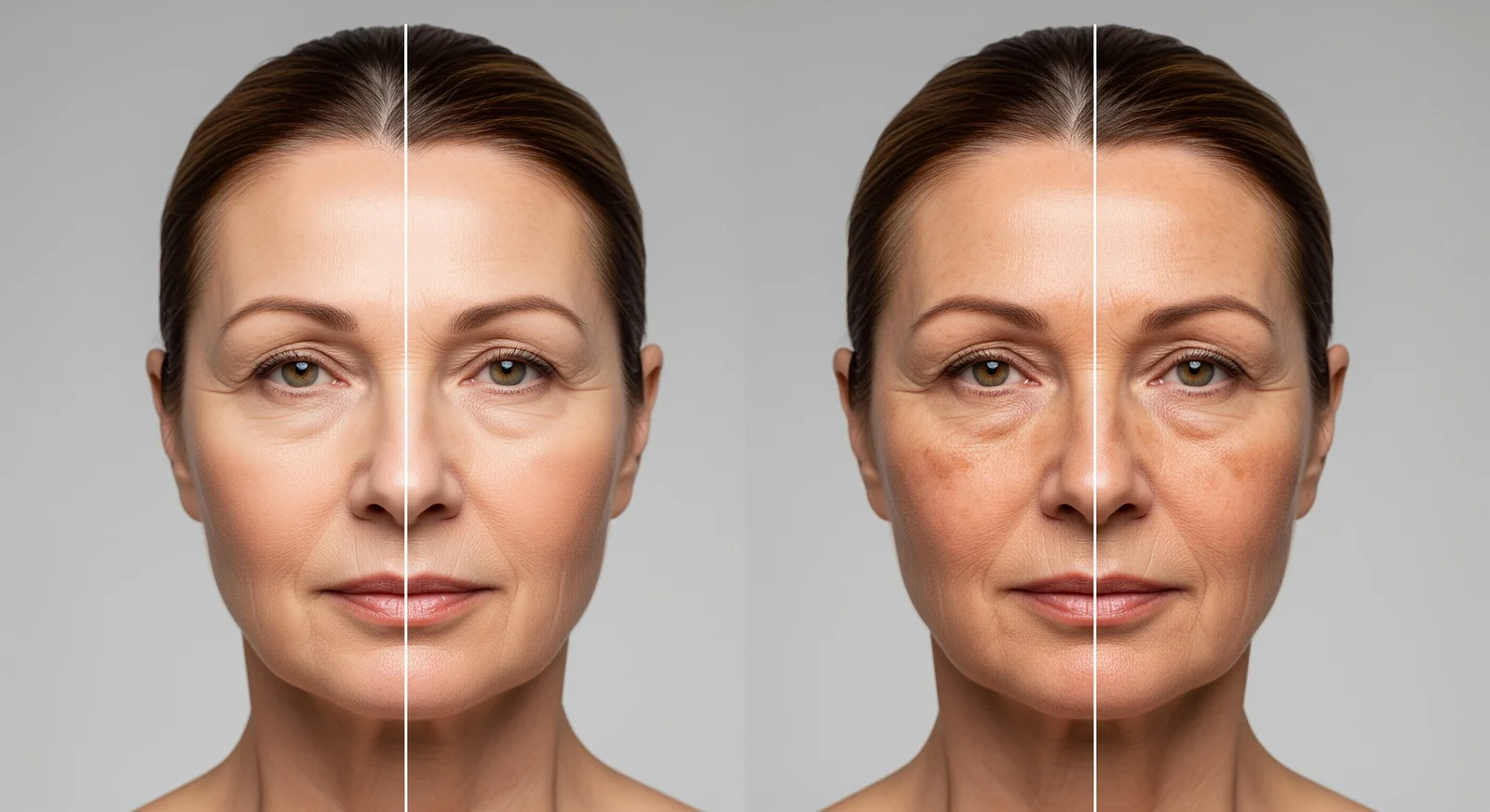

Does SPF in daily skincare really make sense? Yes, and every single day. Many people still treat sunscreen as something for summer and the beach. That is a mistake, and it can affect both the health and the appearance of your skin. UV radiation is at work all year round, including when it is cold or cloudy, or when we are sitting by a window. Even on cloudy days, up to 80% of UV gets through the clouds, and UVA also passes through window glass. Using sunscreen every day is one of the most effective ways to protect yourself against photoageing, pigmentation and, most importantly, skin cancer.
SPF is not only there to prevent sunburn. The most serious effects are the ones that build up over the years: wrinkles, loss of firmness, uneven skin tone and a higher risk of skin cancer. That is why sunscreen should be as much of a daily habit as brushing your teeth or applying moisturiser. It is a simple step that gives your skin a chance to renew itself instead of constantly fighting the harmful effects of the sun.
What does SPF stand for?
SPF (Sun Protection Factor) is a measure of protection against UVB radiation. UVB is responsible for tanning and sunburn, but it can also cause skin cancer. The number next to SPF tells you how many times longer you can stay in the sun without burning than you could without protection. For example, SPF 30 means protection for roughly 30 times longer.
But that is only part of the picture. We are also exposed to UVA radiation, which makes up as much as 95% of all UV. It is present all year round, penetrates deep into the skin and speeds up ageing. On the packaging, look for the PA marking (with plus signs) or UVA in a circle, as well as the words “broad spectrum”. The more plus signs after PA, the higher the UVA protection. Products like these protect against both UVB and UVA.

Why does SPF protection matter every day?
UVA is with us all the time. It passes through clouds and window glass, so it also does damage in the office, in the car and in winter. Small but regular doses cause micro-damage over time. The result: wrinkles, dark spots and a higher risk of skin cancer. Dermatologists point to SPF as the most effective anti-ageing product and the foundation of skin cancer prevention.
Your skin is your largest organ and it responds to your everyday habits. Skipping sunscreen is like going out in the rain without an umbrella. The effects are not always visible straight away, but years later they are serious. A well-chosen sunscreen is a long-term investment in healthy, smooth skin. Regular SPF helps rebuild the skin’s protective barrier instead of constantly repairing sun damage.
How does SPF work at skin level?
Sunscreen filters work in two ways. Chemical (organic) filters absorb UV rays and turn them into heat, like a sponge that “catches” the radiation. Mineral (physical) filters, such as zinc oxide and titanium dioxide, form a layer on the skin that reflects and scatters UV, rather like tiny mirrors. They work as soon as they are applied.
Both types reduce the amount of UV reaching the skin, limiting DNA damage, mutations and oxidative stress. As a result, they protect against sunburn, photoageing, pigmentation and skin cancer (including melanoma). Good “broad spectrum” creams work against both UVB and UVA, protecting the deeper layers of the skin and the collagen and elastin fibres responsible for firmness.
Benefits of using SPF in daily skincare
Daily SPF is more than a shield against the sun. It is a simple skincare plan with long-term results: a better appearance, a healthier complexion and less damage in the future. Adding sunscreen to your morning routine is one of the easiest ways to keep your skin looking younger and in good condition for years.
As awareness of how the environment affects the skin has grown, SPF has become the basis of sensible skincare. It protects, and it also helps in the fight against dark spots and loss of firmness. Prevention always beats repairing damage.
Preventing skin photoageing
Photoageing is premature ageing caused by UV, and it accounts for as much as 80% of the visible signs of ageing. UVA damages collagen and elastin: the skin loses its springiness, and wrinkles and roughness appear. Daily sunscreen blocks these processes and protects the skin’s supporting fibres.
With regular use, the skin stays smooth and elastic for longer. Sunscreen slows photoageing and gives the skin time to renew itself. Many creams also contain antioxidants (such as vitamins C and E) that help counter oxidative stress.
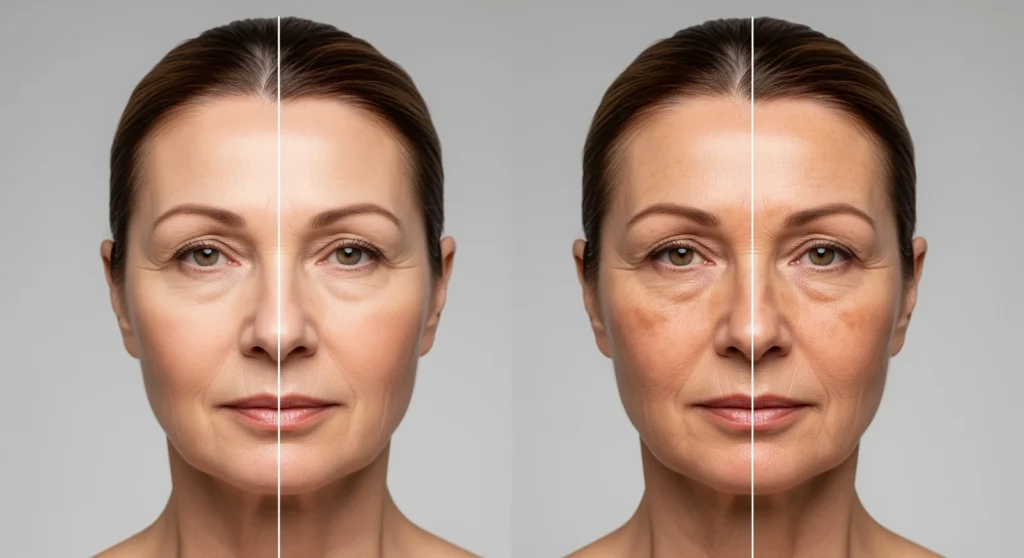
Protection against pigmentation and loss of firmness
UV boosts melanin production, which leads to sun spots and melasma. SPF limits this trigger and reduces the risk of new pigmentation and of existing spots getting darker. This is especially important if you are prone to hyperpigmentation.
UV also weakens collagen and elastin, which leads to laxity and wrinkles. Sunscreen helps maintain springiness and a more defined facial contour. So it works on two fronts: the colour and the structure of the skin.
Keeping an even skin tone
Without protection, the skin easily turns red, gets irritated and tans unevenly. Sunscreen acts as a barrier that limits these reactions and supports a calm, even tone.
SPF also reduces the risk of spider veins (telangiectasia) and UV-induced inflammation. This matters for sensitive skin that is prone to redness. The result is a healthier, rested look without having to cover up with makeup.
Reducing the risk of skin cancer
This is the most important benefit of daily protection. UV is the main cause of skin cancer: melanoma, basal cell carcinoma and squamous cell carcinoma. In Poland, the number of melanoma cases has risen by 300% in 20 years, and around 100,000 cases of skin cancer are diagnosed every year. More than five second-degree sunburns before the age of 20 increase the risk of melanoma by 80%.
High-SPF, broad-spectrum products protect the DNA of skin cells and limit mutations. Clinical studies show that regular sunscreen use reduces the risk of skin cancer. It is a simple way to protect your health and your life.
Types of SPF sunscreen for everyday use
Choosing a sunscreen can be tricky, because the names and types can be confusing. The two you will come across most often are mineral (physical) and chemical. Both protect effectively, but they differ in their properties and in how they feel on the skin.
The key is to choose a formula that suits your skin type and lifestyle. The right sunscreen is the one you actually use every day, and in the right amount.
Mineral vs chemical filters: differences and advantages
Mineral filters are zinc oxide and titanium dioxide. They act like a shield that reflects UV, are highly stable and are less likely to cause irritation, so they are recommended for people with sensitive skin and for children. They work straight after application.
Chemical filters (such as octocrylene, avobenzone, bemotrizinol and octinoxate) absorb UV and “convert” it into heat. They are lightweight, usually leave no white cast and work well under makeup. In the EU, every filter is carefully assessed by the SCCS before it can be sold.
| Feature | Mineral filters | Chemical filters |
| Mechanism | Reflect and scatter UV | Absorb UV and release it as heat |
| Starts working | Immediately | Once absorbed |
| Risk of irritation | Low | Low/moderate (depending on the formula) |
| Finish | May leave a white cast | Usually invisible |
| Skin type | Sensitive, children | Oily, combination, under makeup |
Which type of sunscreen should you choose for different skin types?
Match the sunscreen to your skin’s needs:
- Sensitive, allergy-prone, children: mainly mineral filters; fragrance-free formulas.
- Oily, combination, acne-prone: light chemical gels/emulsions labelled “non-comedogenic” and “oil-free”, often with niacinamide or silica.
- Dry, dehydrated: richer chemical formulas with hyaluronic acid, glycerin and oils.
- Mature: sunscreens with added antioxidants and peptides. Blends of mineral and chemical filters often work particularly well.

Choosing the right SPF cream for daily skincare
A well-chosen SPF is the foundation of good protection and comfortable use. There are many options on the market, so it is easy to get lost. It helps to focus on a few simple rules so that your skin is well protected and cared for.
The right sunscreen is one you like and reach for every day. It should not leave a white cast, clog pores or leave a heavy film. Ideally, it should care for your skin as well as protect it.
What should you look for when choosing SPF?
- Broad protection: “broad spectrum” or UVA in a circle; a high PA/PPD rating for UVA.
- Factor: at least SPF 30 for everyday use, and SPF 50 is often better.
- Suited to your skin: light formulas for oily/combination skin; richer ones for dry skin; fragrance-free and gentle ones for sensitive skin.
- Ingredients: avoid too much alcohol, and choose trusted brands and products from reliable sources.
Which SPF for every day: 30, 50 or higher?
Specialists recommend at least SPF 30, ideally SPF 50. The difference in the percentage of UVB blocked is small (about 97% vs 98%), but most people apply too little product. A higher SPF is more “forgiving” of a layer that is too thin and gives better protection in real life.
SPF 50+ is essential when you spend longer in the sun: on the beach, in the snow, on the water or in the mountains. For short trips outside, SPF 30 may be enough, but 50 is the safer choice. No sunscreen protects 100%: what counts is correct application and regular reapplication.
Water resistance and other SPF properties
If you are active, swim or sweat a lot, look for “water resistant” (40 or 80 minutes in contact with water). Always reapply after getting out of the water, sweating or towelling off.
Many sunscreens contain added skincare ingredients, for example:
- Moisturising: hyaluronic acid, glycerin
- Antioxidants: vitamins C and E, plant extracts
- Soothing: allantoin, panthenol
- For oily skin: niacinamide
Formulas like these combine protection and skincare in one step.
Products for sensitive, oily, dry and acne-prone skin
For oily, combination and acne-prone skin, the most suitable options are light “non-comedogenic”, “oil-free” gels or fluids, often with a mattifying effect (for example niacinamide or silica).
Dry and dehydrated skin will appreciate richer textures with glycerin, hyaluronic acid, shea butter or oils. For sensitive and allergy-prone skin, choose fragrance-free formulas, often mineral and alcohol-free. Mature skin will benefit from sunscreens with antioxidants, peptides or repair enzymes.
SPF for face and body: which formulas to choose?
The face tends to be more sensitive and is often covered with makeup, so lighter, non-comedogenic formulas with added skincare ingredients work well here.
For the body, choose easy-to-use sprays, lotions or balms. Go for a high SPF (at least 30, ideally 50) and broad-spectrum protection. If you are active or swimming, you need a water-resistant version. Protect all exposed areas: hands, neck, décolletage and ears, which we often forget about.
How to use SPF correctly in daily skincare
How well it works depends not only on the factor but also on how much you apply and how. Even a very good sunscreen will not help if you use too little, apply it too rarely or put it on in the wrong order.
Consistency and thoroughness are what matter. UV is at work all day and the damage adds up. Reapplying during the day is just as important as the morning application.
When should you apply sunscreen to your face and body?
Sunscreen is the last step of your morning skincare before makeup. Apply it 15-30 minutes before going out. Always apply mineral filters last (they form a layer on the skin). Light chemical ones can go on after your moisturiser; ideally on clean, moisturised skin.
On the body, apply sunscreen to all exposed areas. Remember your ears, the back of your neck, the backs of your hands, your feet and your hairline. UVA passes through window glass, so you also need protection indoors near a window.
How much SPF cream should you use?
This is where most people go wrong. To get the protection stated on the label, you need about 2 g for the face (the so-called two-finger rule), which is roughly half a teaspoon. For an adult’s whole body, about 30 ml (a small shot glass).
Spread the sunscreen evenly and give it a moment to absorb. It is better to apply more than less: a thin layer significantly lowers the real SPF.
How often should you reapply SPF during the day?
As a rule, every 2-3 hours. More often when the sun is strong: a UV index above 6, a shadow shorter than you are (around 10:00-16:00), the beach, snow, water, the mountains or long periods in the sun. Reapply after swimming, sweating and towelling off.
In milder conditions (short trips outside, driving, an office away from the window), one top-up is enough. If you wear makeup, use a spray, powder or cushion compact with SPF.
Can sunscreen be combined with other skincare products?
Yes. Apply sunscreen after serum and moisturiser, and before makeup. Give each layer a moment to absorb to avoid pilling. Treat foundation with SPF as an extra, not a replacement for sunscreen: nobody applies enough of it to get full protection.
Many sunscreens work well with makeup and can act as a primer, smoothing the skin and helping makeup last longer.
Common mistakes when using SPF every day
- Too little product: the real level of protection can drop by as much as half.
- Not reapplying during the day: sweat, friction and time weaken the sunscreen.
- Skipping sensitive areas: ears, eyelids, lips, the back of the neck, the backs of the hands.
- Sunscreen only in summer: UVA is present all year round, including through window glass.
- A formula that does not suit your skin type: it puts you off using it regularly.
- Using expired products: they may no longer protect you.
Removing SPF sunscreen at the end of the day
In the evening, cleanse your skin thoroughly in two steps:
- Remove makeup and dissolve the sunscreen: a cleansing oil, balm or micellar water (oils work very well on water-resistant formulas).
- Wash with a gel or foam to remove any residue and impurities.
This helps prevent blackheads and irritation, and prepares the skin for your serum and night cream.
Practical tips for using SPF every day
Sunscreen has to work in real life: at work, on the go, under makeup and during exercise. A few simple tricks make daily use and reapplication easier.
Small habits make a big difference. They help your skin stay smooth, firm and free of dark spots for longer.
Protecting your lips, eyelids and ears from the sun
- Lips: always carry a lip balm with SPF 30+.
- Eyelids: a gentle, fragrance-free fluid or stick with SPF.
- Ears, back of the neck, hairline: apply cream just as you do on your face; a stick makes it easier to reach awkward spots.
These areas are highly exposed, yet we often skip them.
SPF under makeup: how to apply it
Apply sunscreen after your skincare and before makeup, and give it 2-5 minutes to set on the skin. Choose light, non-comedogenic formulas. Treat foundation with SPF as support, not a replacement. Using enough SPF is essential, even when you plan to wear full makeup.
Reapplying SPF during the day when you are out
When you are on the move, these work well:
- Mists/sprays with SPF: spray from 10-15 cm away for 4-6 seconds, then pat in lightly.
- Mineral powders with SPF: a quick top-up over makeup.
- Sticks: go over the same area at least four times (up-down-up-down).
Carry sunscreen with you and reapply more often in strong sun, after swimming and after sweating.
Common questions and myths about everyday SPF
There are many myths about SPF. Clearing up doubts helps you build good habits and protect your skin better.
Knowing how sunscreens work and why to use them makes everyday decisions easier and improves the results of your skincare.
Does SPF block vitamin D production?
No. No sunscreen blocks 100% of UV. SPF 30 lets through about 3% and SPF 50 about 1-2%, which is enough for the skin to produce vitamin D. Besides, most people do not apply the ideal amount of sunscreen or reapply it often, so exposure happens anyway.
A short exposure of bare skin for about 15 minutes between 10:00 and 15:00 (from May to September) is enough to produce vitamin D. Diet (oily fish, eggs) and supplements also matter.
Should you use SPF in winter and on cloudy days too?
Yes. UVA is present all year round, and as much as 80% of UV gets through clouds. UVA passes through window glass, so it also reaches you at home, in the office and in the car. In winter, snow reflects up to 80% of UV, so the dose increases on the ski slopes. Cold and low humidity weaken the skin barrier, which leaves it even more exposed.
Daily sun protection 365 days a year helps limit cumulative damage: dark spots, uneven skin tone and wrinkles.
Does SPF cream cause blackheads?
Not SPF itself, but a poorly chosen, heavy formula can clog pores. Choose light products labelled “non-comedogenic” and “oil-free”. Acne-prone skin especially needs protection, because UV makes post-inflammatory dark marks more persistent. Thorough two-step cleansing in the evening is also important.
Does expired SPF still protect?
No. After the expiry date, filters can lose their effectiveness. An old product may also change in smell and texture and be more likely to cause irritation. Always check the dates (including the PAO) and throw away expired products.
Summary of the key rules for using SPF in daily skincare
SPF is a daily habit that genuinely protects your skin all year round. UV works regardless of the weather and where you are, and its effects build up, leading to photoageing, pigmentation and skin cancer. Make sunscreen part of your morning routine, without exception.
Remember:
- Broad protection (UVA + UVB) and a high factor: at least SPF 30, ideally 50.
- A formula that suits your skin type and a texture you enjoy using: this makes regular use more likely.
- Amount: the two-finger rule for the face; about 30 ml for the body.
- Order: sunscreen as the last step of your skincare, before makeup.
- Reapply every 2-3 hours and after contact with water or sweating.
- Do not skip your ears, eyelids and lips.
Daily sunscreen is a simple way to keep your skin smooth, firm, even and healthy, today and in the future
