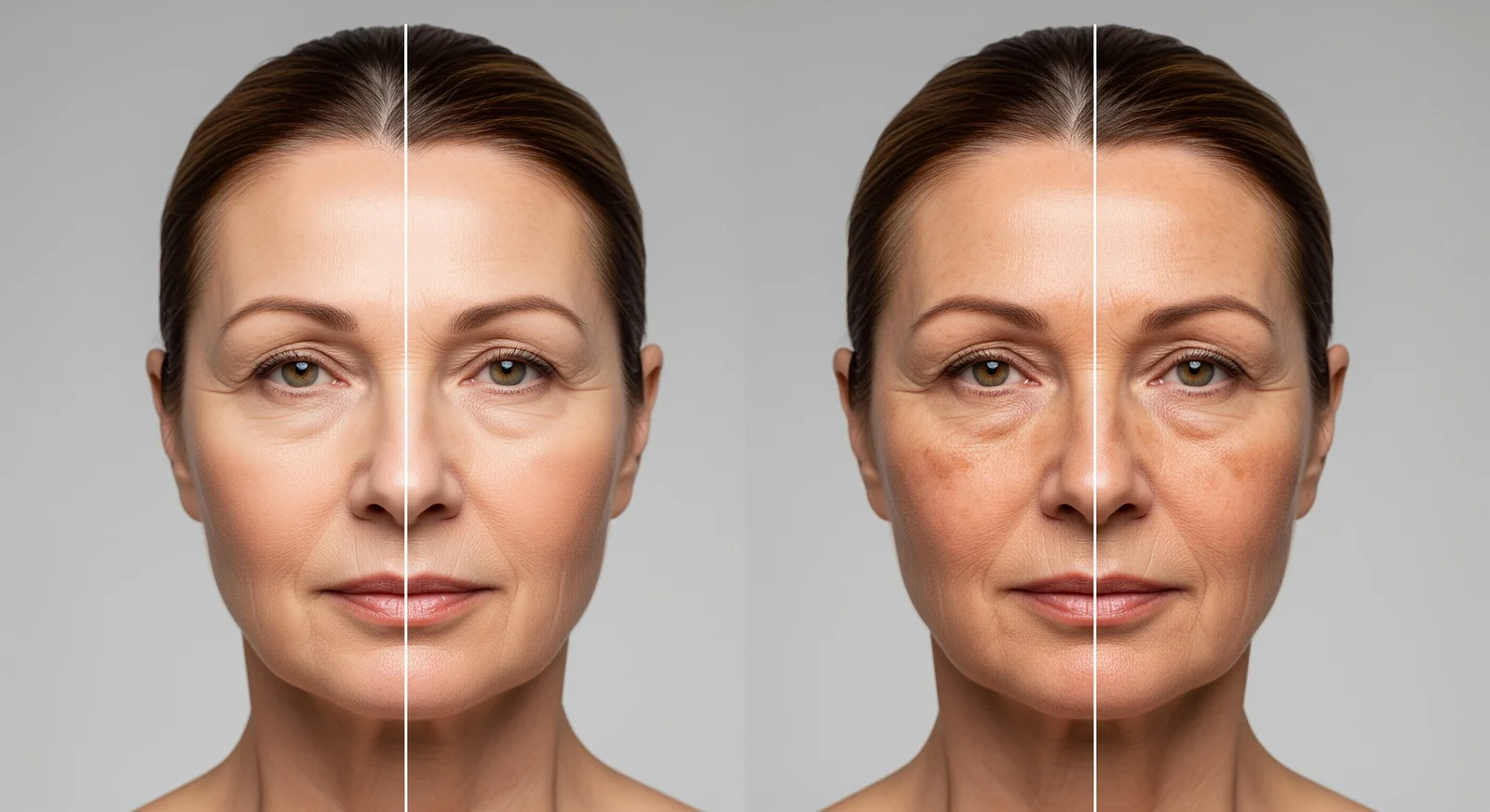










































Life moves fast, and every day your skin comes into contact with many external factors. So the question of whether it makes sense to use vitamin C in skincare comes up more and more often. The answer is simple: vitamin C is a strong ally in caring for healthy, radiant and youthful-looking skin. It is good not only for the body as a whole but also in skincare products, as scientific research confirms.
Adding vitamin C products to your daily routine is a good long-term decision. This ingredient works in many ways: it protects against oxidative stress, stimulates collagen production, fades pigmentation and strengthens the skin barrier. It suits people of different ages and with different skin types, because you can choose a form and concentration that match your needs. That is why vitamin C is one of the most popular active ingredients in skincare products.

Vitamin C in skincare: what is it and how does it work?
What makes vitamin C stand out in skincare?
Ascorbic acid (vitamin C) is an important ingredient in skincare. The body cannot produce it on its own, and only a small amount of what we get from our diet reaches the skin. That is why applying it directly to the skin matters so much. It has been valued for years for how well it works, and its nickname, “the youth vitamin”, did not come out of nowhere.
Its strength lies in its broad, research-backed range of effects. It is best known for its powerful antioxidant properties, which help slow down premature ageing.
What are the main ways vitamin C works on the skin?
- Antioxidant action: it neutralises free radicals and limits damage to DNA, lipids and proteins, so the skin ages more slowly.
- Collagen: it stimulates the synthesis of collagen, which is responsible for firmness and elasticity. Collagen decreases over time, and vitamin C helps rebuild the fibres. Long-term use can increase collagen production by as much as eightfold.
- Brightening: it inhibits tyrosinase (the enzyme that produces melanin), which evens out skin tone and limits new pigmentation.
- Skin barrier: it supports lipids and ceramides, which improves hydration and makes the skin less susceptible to irritants.
- Soothing action: it calms inflammation and redness, which helps with sensitive skin and skin prone to broken capillaries.
- Support for sun protection: it boosts the effect of UV filters.
Why use vitamin C in your facial skincare?
Key benefits for the skin
- A powerful antioxidant: it reduces the effects of smog, UV, stress and a poor diet.
- Collagen support: the skin becomes firmer, smoother and more elastic.
- Brightening: it reduces sun spots, post-inflammatory marks and hormonal pigmentation.
- Soothing action: it reduces redness and supports the healing of blemishes.
Results of using vitamin C products regularly
With consistent use, the complexion becomes brighter, more even and more radiant. Wrinkles are less visible and the skin gains firmness. A stronger barrier helps the skin cope better with pollution and changes in temperature. Hydration levels also rise, which means more comfort and less dryness.
Vitamin C provides good support for sun protection. Applied under an SPF sunscreen, it boosts the sunscreen’s effect. It is a good choice all year round, not only in autumn and winter. The complexion looks healthier and signs of tiredness are less visible.
Who will benefit most from vitamin C?
- Mature skin: smoothing of wrinkles, improved firmness and elasticity.
- Acne-prone skin: help in reducing post-inflammatory marks, plus a soothing effect.
- Sensitive skin and skin prone to broken capillaries: less redness and more comfort (once a gentle form has been chosen).
- Normal skin: anti-ageing prevention and a healthy glow.
Types of vitamin C used in skincare products
L-ascorbic acid (Ascorbic Acid): strong action and potential challenges
L-ascorbic acid (INCI: Ascorbic Acid) is the pure and most extensively studied form of vitamin C. It gives fast results in brightening and fading pigmentation, and it is often chosen for oily skin and skin with dark spots. It does have drawbacks, though: it oxidises easily (light, air, heat, unsuitable pH), so it loses potency, turns brown or orange and changes its smell. It works most effectively at a low pH (about 3-3.5), which can cause burning and redness in sensitive skin. If you choose this form, look for a concentration of 15-30%, dark opaque packaging and stabilising additives (e.g. vitamin E, ferulic acid). Also expect a shorter shelf life and the need to use the product up quickly.
Stable and gentle vitamin C derivatives
To limit oxidation and irritation, more stable and gentler derivatives have been developed. They work well for sensitive skin, skin prone to broken capillaries, and during pregnancy and breastfeeding.
Ascorbyl tetraisopalmitate (Tetrahexyldecyl Ascorbate)
INCI: Tetrahexyldecyl Ascorbate/Ascorbyl Tetraisopalmitate. It is oil-soluble, penetrates deep into the skin easily, and is very stable and gentle. It works well even at concentrations of 1-3%. It brightens, supports collagen and protects against free radicals. It is more expensive, but it suits most skin types, including sensitive skin.
Magnesium Ascorbyl Phosphate and Sodium Ascorbyl Phosphate
MAP (the magnesium salt) and SAP (the sodium salt) are water-soluble, stable derivatives that are gentler than the pure acid. MAP has a low potential for irritation and is recommended for sensitive skin and for preventing melasma; its antioxidant action is slightly weaker than that of ascorbic acid, but at concentrations from about 15% it brightens well and supports plant extracts. SAP works in a similar way but also has stronger antibacterial properties, which helps acne-prone skin. They penetrate less well than Tetrahexyldecyl Ascorbate, but the skin usually tolerates them very well.
Ascorbyl Glucoside and other gentler forms
Ascorbyl Glucoside is vitamin C bound to glucose: it is stable and less irritating than L-ascorbic acid. It keeps its antioxidant action, brightens and supports collagen, and it also penetrates well. A good choice for sensitive skin. Ascorbyl Palmitate (oil-soluble) is also more stable and gentler than pure vitamin C; it brightens, has an anti-inflammatory effect and soothes redness after sun exposure. Newer forms are increasingly taking its place, but it is still used in many formulas.
3-O-Ethyl Ascorbic Acid: a new generation of vitamin C
3-O-Ethyl Ascorbic Acid is a modern derivative that stays highly stable when exposed to light and heat. It penetrates well and rarely irritates, even at higher concentrations. It combines effectiveness with gentleness. It also has anti-inflammatory and antibacterial properties. It is the only form that dissolves in both water and oil, which makes it easier to create different types of products.
| Form | Solubility | Typical concentration | Who it suits | Strengths/Challenges |
| L-Ascorbic Acid | Water | 10-30% | Pigmentation, oily skin | Very effective, but unstable and may irritate |
| Tetrahexyldecyl Ascorbate | Oil | 1-3% | Most skin types, including sensitive skin | High stability, good penetration, higher price |
| MAP | Water | ≥15% | Sensitive skin, melasma prevention | Gentle, slightly weaker antioxidant |
| SAP | Water | 5-10%+ | Acne-prone skin | Antibacterial properties |
| Ascorbyl Glucoside | Water | 5-10%+ | Sensitive skin | Stable, well tolerated |
| Ascorbyl Palmitate | Oil | 0,5-2%+ | Skin that needs gentle care | Gentle, but weaker penetration |
| 3-O-Ethyl Ascorbic Acid | Water and oil | 1-15% | Most skin types, including sensitive skin | Very stable, versatile |
How do you choose the right vitamin C product?
What to look for in the INCI ingredient list
- Check the concentration. For L-ascorbic acid, 10-15% or more is usually effective. For stable derivatives (e.g. THD Ascorbate), 1-3% is often enough.
- If the concentration is not given, look at where the ingredient appears in the list. The higher up it is, the more of it the product contains.
- If “Ascorbic Acid” is at the end of the list, it may act mainly as a preservative, and its skincare effect will be small.
- For sensitive skin, choose gentler forms: MAP, SAP, Ascorbyl Glucoside, THD, 3-O-Ethyl Ascorbic Acid.
Stability, packaging and how well the product works
L-ascorbic acid oxidises easily, so packaging matters a great deal. Look for dark, opaque bottles with a pump or dropper, which limit exposure to air and light. Clear glass speeds up oxidation. Stable derivatives (e.g. THD, 3-O-Ethyl) are more resistant and cope better with different types of packaging. If a serum has turned orange/brown or smells different, it works less well and may irritate: replace it with a new one.
Storing vitamin C products
Keep products in a cool, shaded place, away from sunlight and heat. Serums with L-ascorbic acid are worth keeping in the fridge to slow down oxidation. Always close the bottle tightly. Check the colour and smell regularly: changes are a sign of oxidation and loss of potency. If that happens, switch to a fresh product.
How to use vitamin C correctly in your daily skincare
When and in what order should you apply vitamin C products?
Vitamin C serum is most often used in the morning, on dry skin after cleansing. This is a good time because it strengthens protection during the day and supports the action of SPF sunscreen.
- Cleansing and drying the skin.
- A few drops of vitamin C serum.
- Moisturising serum/cream (if needed).
- A cream with high SPF.
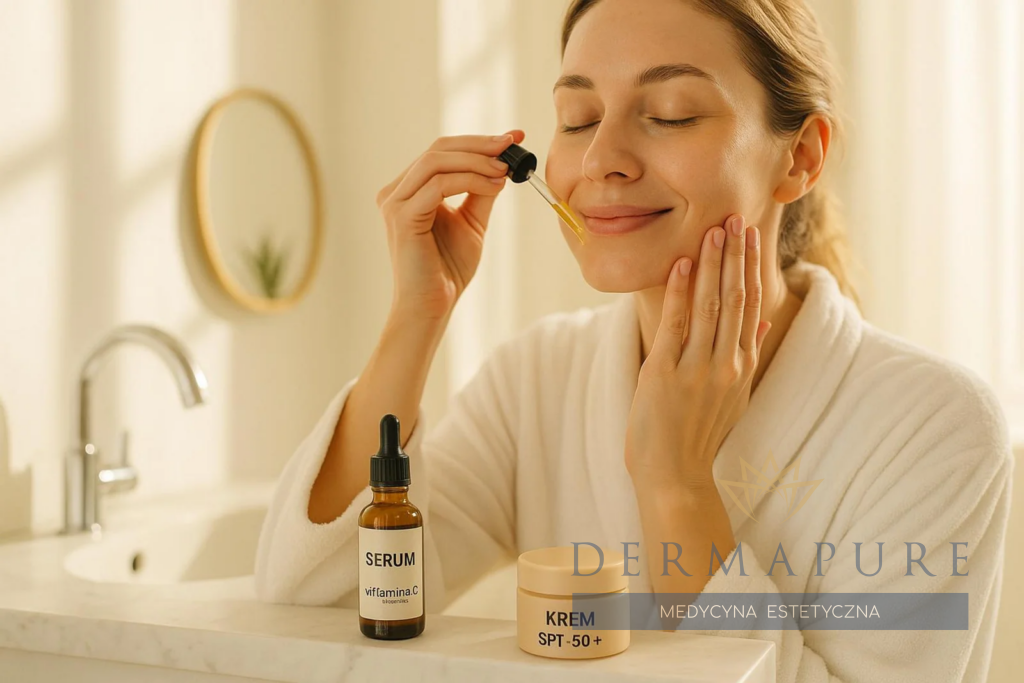
You can also use vitamin C in the evening to support regeneration and elasticity. Watch how your skin reacts. To start with, choose lower concentrations and apply every other day, then gradually use it more often.
Does vitamin C suit every skin type?
Yes, if you choose the right form and concentration. For oily and combination skin and skin with pigmentation, L-ascorbic acid in higher concentrations gives fast results but can irritate. For sensitive skin, skin prone to broken capillaries, and during pregnancy and breastfeeding, derivatives are a better choice: THD, MAP, SAP, 3-O-Ethyl. Mature skin will benefit from the anti-wrinkle effect whatever the form. Normal skin will gain antioxidant protection and radiance. Always watch your skin and adjust the product to how it reacts.
Serum, cream or toner: how do you choose the right product?
A serum has the strongest action because it contains higher concentrations and penetrates easily. Apply it after cleansing, before your cream. It may have a light water or oil base: the choice depends on what your skin needs.
Vitamin C creams are gentler and often also hydrate or nourish the skin. They are a good option for sensitive skin or if you prefer a simple routine. Toners usually have lower concentrations; they refresh, balance the pH and prepare the skin for the next steps. A toner is an addition, not a replacement for a serum or cream. If you want fast results, choose a serum. If you want a gentler action and more comfort, reach for a cream. A toner will round off your routine.
What to combine vitamin C with, and what to avoid
Safe combinations: antioxidants and UV filters
- Vitamin C + vitamin E: their combined antioxidant action gives better protection.
- Ferulic acid: improves stability and helps protect against UV.
- Hyaluronic acid: hydrates and supports elasticity.
- Peptides: together they support regeneration and collagen.
- UV filters: apply vitamin C under SPF to boost sun protection.
Risky combinations: retinoids, acids and niacinamide
Some combinations can irritate the skin too much or weaken the effect.
- L-ascorbic acid + retinoids: both ingredients are strong, and together they can cause redness, burning and dryness. A better split: vitamin C in the morning and retinoids in the evening, or on different days.
- L-ascorbic acid + AHA/BHA: combining two strong active ingredients can increase irritation and weaken the barrier. Use them at different times of day or alternate them.
- L-ascorbic acid + niacinamide: the different pH can weaken their action and sometimes lead to redness (nicotinic acid). With vitamin C derivatives the risk is lower. It is safer to apply them separately (e.g. morning/evening).
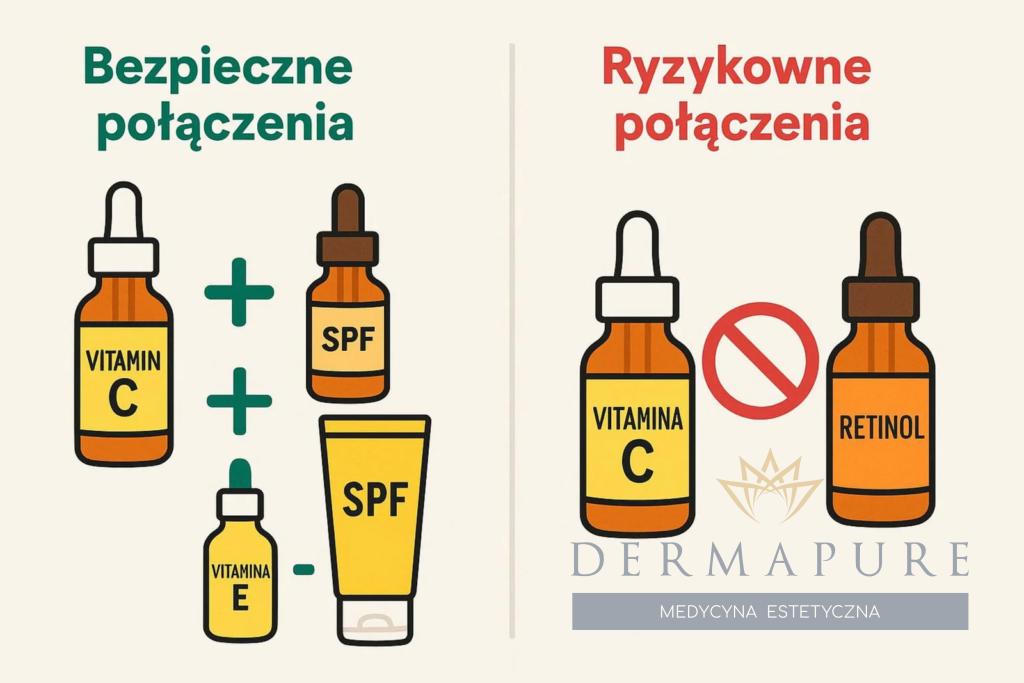
If in doubt, discuss your skincare plan with a specialist.
Can vitamin C cause side effects?
Irritation, allergies and how to prevent them
Burning, redness, a feeling of warmth or itching sometimes appear, especially with L-ascorbic acid and sensitive skin. This is usually not serious and passes once the product is washed off.
- Match the form and concentration to your skin type: for sensitive skin, choose 5-10% or derivatives (THD, MAP, 3-O-Ethyl).
- Start slowly: every other day, then more often.
- Apply to clean, dry skin.
- Don’t combine it straight away with retinoids or AHA/BHA in the same step if you don’t yet know how your skin reacts.
Tips for a skin tolerance test
- Apply a small amount of the product behind your ear, along the jawline or on the inner forearm.
- Watch the area for 24-48 hours.
- If there is no redness, burning, itching or rash, you can add the product to your routine.
- Start by using it every other day; after 1-2 weeks, if all is well, move on to daily use.
- If you notice any unwanted symptoms, stop using the product and contact a dermatologist.
Vitamin C for pigmentation and uneven skin tone
How does vitamin C fade pigmentation?
Vitamin C inhibits tyrosinase, the enzyme responsible for producing melanin. This limits excess pigmentation and lightens existing spots (sun spots, post-acne marks, hormonal pigmentation). As an antioxidant, it also reduces the impact of free radicals, which intensify skin darkening. It supports cell renewal, which helps the skin shed cells containing excess melanin. The result is a brighter, more even skin tone and a visible improvement in radiance.
When to use it for pigmentation problems
- Sun spots after too much sun exposure without proper protection.
- Post-inflammatory pigmentation after acne lesions.
- Melasma: hormonal pigmentation, e.g. during pregnancy.
Vitamin C also helps prevent new spots thanks to its antioxidant action and by strengthening the skin barrier. For pronounced pigmentation, it is worth considering adding exfoliating acids/retinoids or brightening ingredients such as arbutin, glutathione or tranexamic acid. Using a high-SPF cream every day alongside it is essential.
Summary: why add vitamin C to your daily skincare?
To sum up: vitamin C is a strong pillar of skincare. It protects the skin from free radicals, supports collagen production, fades pigmentation, evens out skin tone, strengthens the barrier and soothes irritation. Thanks to its various stable and gentle forms, it can be matched to almost any skin type.
Whether you choose an intensive serum with L-ascorbic acid or a gentler derivative (e.g. THD), what matters most is regularity and daily SPF protection. Together, they bring long-term benefits: healthier-looking skin, more radiance and a younger look for longer.